Traditional Attire
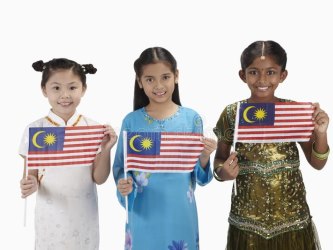
From magnificent tribal head-feathers with bark body-covers to antique
gold-woven royal songket fabric, the array of Malaysia's traditional costumes
and textiles are stunningly diverse and colourful.
In the early days, the aboriginal tribes wore native bark costumes and beads.
With the advent of the ancient kingdoms, hand-loomed fine textiles and intricate
Malay batik were used by the Malay royalty. As foreign trade flourished,
costumes and textiles such as Chinese silk, the Indian pulicat or plaid sarong
and the Arabian jubbah a robe with wide sleeves were introduced to the country.
Today, traditional attire such as the Malay baju kebaya, Indian saree and
Chinese cheongsam are still widely worn.
Malay
Before the 20th century, Malay women still wore kemban, just sarongs tied above
the chest, in public. As Islam became more widely embraced, they started wearing
the more modest yet elegant baju kurung. The baju kurung is a knee-length
loose-fitting blouse that is usually worn over a long skirt with pleats at the
side. It can also be matched with traditional fabrics such as songket or batik.
Typically, these traditional outfits are completed with a selendang or shawl or
tudung or headscarf.
The traditional attire for Malay men is the baju melayu. The baju melayu is a
loose tunic worn over trousers. It is usually complemented with a sampin - a
short sarong wrapped around the hips.
Chinese
Comfortable and elegant, the traditional cheongsam or 'long dress' is also a
popular contemporary fashion choice for ladies. Usually, it has a high collar,
buttons or frog closures near the shoulder, a snug fit at the waist and slits on
either one or both sides. It is often made of shimmering silk, embroidered satin
or other sensual fabrics.
Indian
The saree is the world-renowned traditional Indian garment. A length of cloth
usually 5-6 yards in width, the saree is worn with a petticoat of similar shade
and a matching or contrasting choli or blouse. Typically, it is wrapped around
the body such that the pallau - its extensively embroidered or printed end - is
draped over the left shoulder. The petticoat is worn just above or below the
bellybutton and functions as a support garment to hold the saree. Made from a
myriad of materials, textures and designs, the saree is truly exquisite.
Popular with northern Indian ladies is the salwar kameez or Punjabi suit; a long
tunic worn over trousers with a matching shawl.
The kurta is the traditional attire for men on formal occasions. It is a long
knee-length shirt that is typically made from cotton or linen cloth.
Baba Nyonya
Chinese immigrants who married Malay partners wore the elegant kebaya that can
be described as traditional haute couture.
Hand-made with great skill using sheer material, its intricate embroidery is
equivalent to the best Venetian lacework. The pièce de résistance is a delicate
needlework technique called tebuk lubang - literally to punch holes. This
involves sewing the outlines of a floral motif on the fabric and cutting away
the insides. When done correctly, the end result is fine lace-like embroidery on
the collar, lapels, cuffs, hem and the two triangular front panels, which drape
over the hips, known as the lapik.
Portuguese-Eurasian
Descended from Portuguese settlers of the 16th century, Melakan
Portuguese-Eurasian's traditional attire reflect their heritage. Dominated by
the colours black and red, men wear jackets and trousers with waist sashes
whilst ladies wear broad front-layered skirts.
Sarawak
With its diverse ethnic groups, Malaysia's largest state, Sarawak, has a
plethora of unique tribal costumes. Using a variety of designs and native
motifs, common materials for the Orang Ulu or upriver tribes are hand-loomed
cloths, tree bark fabrics, feathers and beads. Sarawak is known for the woven
pua kumbu of the Iban tribe, songket of the Sarawak Malay, colourful beaded
accessories, traditional jewellery and head adornments.
Sabah
Like Sarawak, Sabah is also blessed with a rich mix of ethnic groups. Each group
adorns attire, headgears and personal ornaments with distinctive forms, motifs
and colour schemes characteristic of their respective tribe and district.
However, culturally different groups who live in close proximity may have
similarities in their traditional attire. Notable hats and headdresses include
the Kadazan Dusun ladies' straw hats, the Bajau woven dastar and the headdress
of the Lotud man, which indicate the number of wives he has by the number of
fold points.
Orang Asli
Traditionally living in the deep jungles of Malaysia, the Orang Asli of
Peninsular Malaysia wore clothing made from natural materials such as tree barks
like the terap, and grass skirts. Ornaments include skillfully woven headbands
with intricate patterns that are made from leaf fronds.
undo About Malaysia